
Trump's Executive Order on Civil Rights
President Trump's revocation of Executive Order 11246 marks a significant shift back to the principles of the Civil Rights Act of 1964 and the 14th Amendment. This move ends decades of race-based policies, returning to a focus on merit over identity.
The old order gave the EEOC a key role in directing government contractors and agencies to follow racial preferences. Trump's executive order changes this, requiring federal entities to embrace true equality without counting by race or gender. It's a return to judging folks by merit—as it was always intended.
"The way to stop discrimination on the basis of race is to stop discriminating on the basis of race."
This quote from Chief Justice Roberts in a 2007 case encapsulates the sentiment behind Trump's actions, bringing the discussion back to its constitutional roots.
Critics might challenge Trump's order, but they'll find it has a solid foundation in the 14th Amendment. With the Supreme Court's originalist majority, partly thanks to Trump's nominations, this order stands on firm constitutional ground.

Supreme Court's Role in Shaping Racial Policies
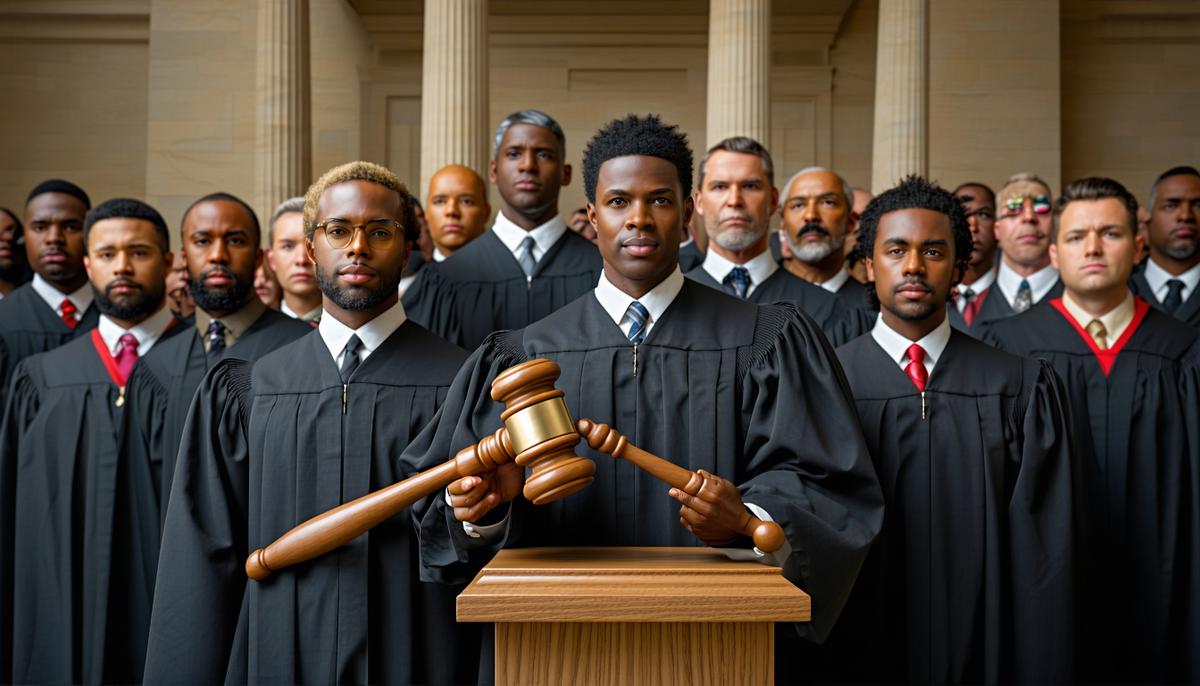
The Supreme Court has played a crucial role in shaping racial preference policies in the U.S. The 1978 Bakke decision allowed race to be considered in college admissions, sparking years of debate over affirmative action.
More recently, the Court has affirmed the original meaning of the 14th Amendment with a solid six-justice majority, thanks in part to President Trump's nominations. The Students for Fair Admissions v. Harvard ruling struck down race-based admissions practices, emphasizing that identity should not be a determining factor.
Chief Justice John Roberts has long advocated for this stance, and the Court has finally aligned with his views. Trump's judicial appointments have amplified the push for a merit-based system, providing strong support for his executive actions.
These rulings provide a sturdy legal foundation for Trump's orders, drawing power from a Supreme Court majority that embraces originalist principles. Trump's executive orders align seamlessly with the high court's stance, steering us towards a more equitable and constitutional future.
Potential Challenges and Implications
While Trump's executive order is grounded in constitutional principles, it may face legal challenges from diversity initiative supporters. However, these challenges might struggle against the Supreme Court's current originalist interpretation.
Institutional Adjustments
- Educational institutions and corporations will need to recalibrate their approaches
- Moving away from identity-focused programs
- Shift may be challenging but could lead to a more equitable foundation based on merit
As federal agencies disband these programs, some may worry about hindering progress in workplace inclusion and diverse representation. However, Trump's orders aim to emphasize achievement and capability over race or background.
The implications extend beyond policy adjustments, sparking renewed legal and public debate on identity politics versus constitutional purity. Supporters see it as a triumph for equality, while critics fear a rollback of social gains.
This national conversation will shape not just laws, but societal norms for future generations. It's an engaging and transformative period, driven by constitutional reverence and a desire for unity through merit. How will this shift impact your community?

- Students for Fair Admissions v. Harvard, 600 U.S. ___ (2023).
- Parents Involved in Community Schools v. Seattle School District No. 1, 551 U.S. 701 (2007).
- Regents of the University of California v. Bakke, 438 U.S. 265 (1978).