
Trump Demands Defunding of NPR and PBS
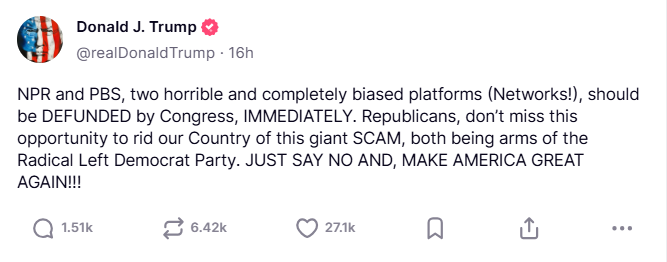
President Donald Trump has once again stirred controversy by calling for Congress to immediately defund National Public Radio (NPR) and the Public Broadcasting Service (PBS). In a fiery post on Truth Social, Trump portrayed these networks as:
- “Agents of the Radical Left Democrat Party”
- A “giant scam” draining taxpayer wallets
- Broadcasters of biased content
Trump rallied Republicans to axe funding, claiming the networks would be better off without federal backing.
This isn’t Trump’s first clash with public broadcasting. Republican leaders have often targeted PBS and NPR for defunding, viewing them as too left-leaning. However, these efforts often falter when legislators consider their local audiences, particularly in rural areas where public broadcasting plays a crucial role.
House GOP Intensifies Scrutiny
The House GOP is turning up the heat on public broadcasters. Rep. Marjorie Taylor Greene pointed to alleged errors in NPR’s COVID-19 reporting and accused PBS of airing “woke” content, including what she termed “drag queen” appearances on children’s shows – a claim swiftly dismissed by PBS CEO Paula Kerger.
Kentucky Rep. James Comer reminisced about listening to NPR on his tractor, highlighting how the media landscape has evolved with more alternatives now available.
Former NPR senior editor Uri Berliner suggested the outlet should forgo taxpayer dollars and pursue a more politically aligned mission. However, NPR’s CEO Katherine Maher insists on their commitment to non-biased journalism while acknowledging past missteps.
Public Support Remains Strong
Despite the political pressure, public support for continued funding remains robust. A recent Pew study found that only a quarter of respondents endorsed cuts to public broadcasting. Meanwhile, PBS maintains its reputation as a trusted news source.
As this debate between funding and ideology continues, the future of public broadcasting in America hangs in the balance, captivating audiences across the nation.
Congressional Hearing Spotlights Editorial Choices
At a recent hearing, Rep. Marjorie Taylor Greene and fellow Republicans scrutinized PBS and NPR’s editorial decisions. Greene focused on:
- NPR’s coverage of COVID-19 origins
- The Hunter Biden laptop story
- Allegations of leftist bias in reporting
PBS faced criticism as well, with Greene alleging “woke” content in children’s programming. Paula Kerger refuted these claims, clarifying that the content in question was an online educational project for adults from a New York station.
NPR Acknowledges Missteps, Reaffirms Commitment
NPR’s Katherine Maher acknowledged previous missteps but reaffirmed the network’s commitment to unbiased journalism. She highlighted efforts to diversify political viewpoints in their coverage, stating:
"We are a non-biased organization."
Some Democrats viewed the hearing as a distraction from more pressing issues. Rep. Stephen Lynch of Massachusetts remarked, “If shame was still a thing, this hearing would be shameful.”
Funding Concerns for Small Stations
The underlying concern remained: how would funding cuts impact smaller stations dependent on federal assistance? This question looms large as the national drama unfolds, pitting government support against media independence.
As this clash continues, the future of public broadcasting in America remains uncertain. Will these institutions weather the storm, or will they be forced to adapt to a new landscape? Only time will tell.
Public Broadcasting Leaders Stand Firm
Paula Kerger and Katherine Maher, leading PBS and NPR respectively, are standing firm against the defunding threat. They argue that cutting federal funding would:
- Severely impact smaller stations
- Harm rural communities
- Jeopardize vital community resources
Maher has acknowledged NPR’s past mistakes and is working to improve the network’s editorial reputation. She’s committed to featuring a diverse range of viewpoints in their coverage.
Public Support and Trust
The American public seems to support continued funding for these networks. A recent Pew Research study shows that most Americans want federal funds to keep flowing to public broadcasting. PBS and NPR have built trust over years with their educational programming and documentaries.
According to a 2024 poll by YouGov, PBS was Americans’ third-most trusted news source after The Weather Channel and the BBC.
Defending Public Broadcasting
The Committee to Protect Journalists defends NPR and PBS as essential public services. Jodie Ginsberg warned against letting bias accusations overshadow the importance of public broadcasting in delivering news, education, and culture.
Whether Trump succeeds in his defunding efforts or not, public broadcasting remains resolute. PBS and NPR continue to stand for unbiased and diverse broadcasting, embodying American values that are too important to ignore.
This tug-of-war for media independence is a story worth following. As the debate continues, the future of public broadcasting in America hangs in the balance, with implications for millions of listeners and viewers across the nation.
- Pew Research Center. Public Broadcasting Funding Study. 2024.
- YouGov. Most Trusted News Sources Poll. 2024.
- PBS NewsHour. Public Broadcasting Funding History. 2024.