
A Tense Oval Office Encounter
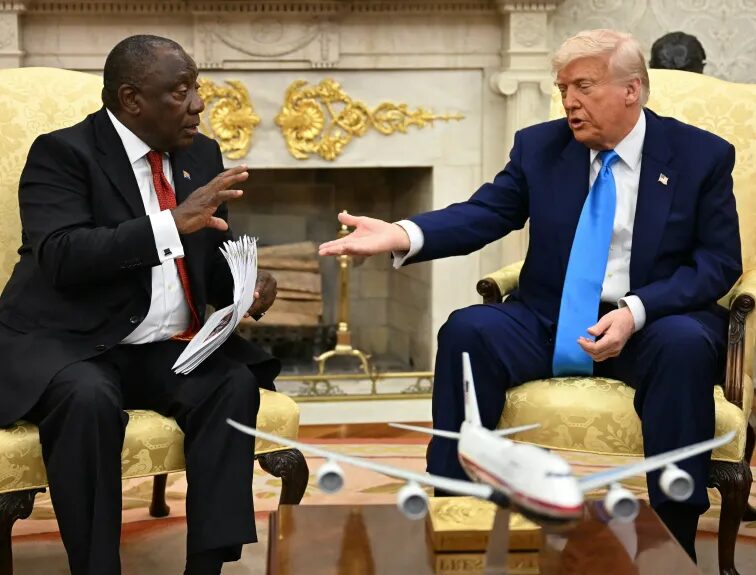
Picture this: the Oval Office, lights dimmed, a room filled with tension. President Donald Trump confronted South African President Cyril Ramaphosa with a video showing rows of white crosses. Trump claimed these marked the graves of White Afrikaner farmers under siege in their own country.
Trump didn’t mince words. He described the crosses as proof of a crisis: “Burial sites—over a thousand—of White farmers,” he declared. He was convinced this showed Afrikaner farmers faced brutal attacks, and he wasn’t keeping quiet about it.
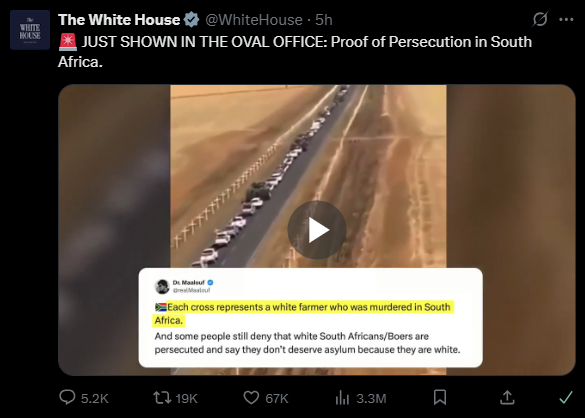
Ramaphosa, staying calm, asked Trump for the location of these images. Trump’s response was direct: “It’s in South Africa, that’s where.” Yet, Ramaphosa and his government denied any claims of genocide targeting the Afrikaner community. “I’d like to know where that is, because this I’ve never seen,” Ramaphosa challenged.
Trump insisted that White South African farmers faced not just land theft but life threats. He compared their situation to acts of genocide, using the term forcefully.
Meanwhile, Ramaphosa defended his nation’s record. He brought representatives like his Minister of Agriculture, who happened to be White, to show a different picture than what Trump painted.
Trump got to the heart of his concerns. He described a scenario where White farmers were targeted and driven from their homes and lands. “Death. Death. Horrible death,” he recounted, emphasizing what he believed were overlooked facts.
This meeting was more than just political theater. It was Trump’s attempt to stir international attention to an issue he felt passionate about, showcasing his bold approach to diplomacy.
Ramaphosa’s Rebuttal
Ramaphosa’s efforts to rebuff Trump’s claims were resolute. He asserted that the images didn’t represent his government’s policy or reality. “That’s not our policy—completely, completely against what he was saying,” he stated firmly.
Ramaphosa pushed for clarity, asking about the location of the supposed burial sites. This question suggested uncertainty around the source and truth of the video content.
Dismissing claims of targeted attacks against White South Africans, Ramaphosa painted a broader picture. He highlighted the issue of crime affecting the entire nation:
"There is criminality in our country,"
he admitted, conveying that violence didn’t discriminate by race.
His defense included showcasing his White Minister of Agriculture, presenting a united front against the genocide claims. “We are a multi-party democracy,” he reminded, pointing out that the voices in the divisive clips were not part of his governance.
As the meeting wrapped up, Ramaphosa shifted focus to trade and collaboration, maintaining an optimistic outlook. He smiled through the intense dialogue, affirming South Africa’s commitment to peace and progress.
Throughout the encounter, Ramaphosa’s persistent message of unity and clarity served as his defense. His response aimed to resonate beyond the walls of the Oval Office, presenting a sovereign nation’s perspective.
Contrasting Perspectives and Expert Opinions
This meeting revealed a clash of perspectives. Trump saw a clear-cut issue: White Afrikaner farmers facing annihilation. He used dramatic flair to showcase what he believed was a crisis in South Africa’s rural landscapes.
Ramaphosa, however, presented a contrasting view rooted in South Africa’s complex social fabric. He depicted violence as a sweeping societal issue affecting all citizens, regardless of race. “Crime really thrives where there is inequality and unemployment,” he noted, emphasizing broader socio-economic challenges.
Expert opinions have consistently debunked the notion of a White genocide in South Africa. Gareth Newham from the Institute for Security Studies highlighted that violence doesn’t distinguish along ethnic lines. Genocide Watch reported that White individuals account for only 2% of homicide victims in South Africa, contrasting with Trump’s claims.
- South African officials reiterated their commitment to multi-racial democracy and inclusivity.
- While South Africa grapples with historical challenges, the government’s stance focuses on fostering unity, tackling crime holistically, and addressing systemic inequalities without racial blame.
Ramaphosa’s subtle diplomacy was evident. His poise under Trump’s scrutiny, coupled with firm yet courteous rebuttals, signified a commitment to truth and reconciliation. His vision seemed directed at empowerment rather than division, countering Trump’s more dichotomous portrayal.
This meeting underscored differing worldviews on confronting internal strife. While Trump took a hard-lined, urgent approach, Ramaphosa offered a nuanced perspective, advocating for dialogue, reform, and healing. Their contrasting declarations highlighted broader themes in international relations, where history, perception, and political will collide.
- Newham G. Institute for Security Studies. Violence and crime in South Africa: A multifaceted issue. 2023.
- Genocide Watch. South Africa: White Genocide Claims Debunked. 2024.
- Tiwana M. CIVICUS. Understanding the complexities of South African society and politics. 2025.