
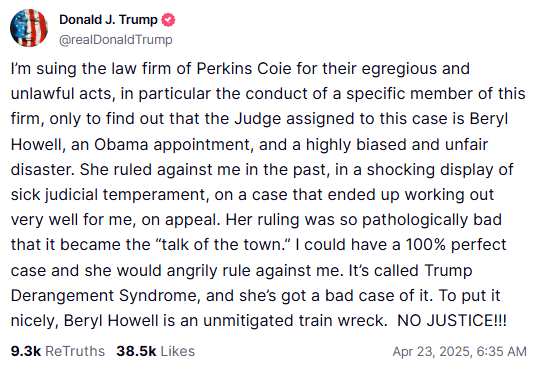
President Donald J. Trump has announced legal action against the law firm Perkins Coie, accusing them of “egregious and unlawful acts.” In a Truth Social post, Trump also criticized U.S. District Judge Beryl Howell, who has been assigned to the case, calling her an “unmitigated train wreck” and alleging bias against him.
This move is the latest in a series of confrontations between Trump and Perkins Coie, a firm known for its work with Democratic clients, including Hillary Clinton’s 2016 campaign. Trump’s executive order last month aimed to sever federal contracts with Perkins Coie’s clients and restrict the firm’s access to federal buildings, citing national security concerns and alleged discriminatory practices.
Perkins Coie Challenges Executive Order
Perkins Coie responded by filing a lawsuit, arguing that the executive order was unconstitutional and retaliatory. Judge Howell issued a temporary restraining order, blocking key provisions of the order, including restrictions on federal contracts and access to government facilities.
Judge Howell, appointed by President Barack Obama, has faced criticism from Trump and his administration, who have accused her of bias due to her previous rulings related to Trump and his associates. The Department of Justice filed a motion to disqualify her from the case, citing past statements and decisions, but the motion was denied.
Broader Implications for the Legal Community
The legal battle has raised concerns within the legal community about potential threats to the independence of legal representation. Judge Howell noted that the executive order could have a chilling effect on the legal profession, stating that it “casts a chilling harm of blizzard proportion across the entire legal profession.”
Perkins Coie has reported losing clients and facing operational challenges due to the executive order, emphasizing the significant impact on their ability to represent clients effectively.
President Trump’s lawsuit against Perkins Coie and his criticism of Judge Howell underscore ongoing tensions between the executive branch and the judiciary. As the legal proceedings continue, the case will likely have significant implications for the balance of power and the independence of legal representation in the United States.